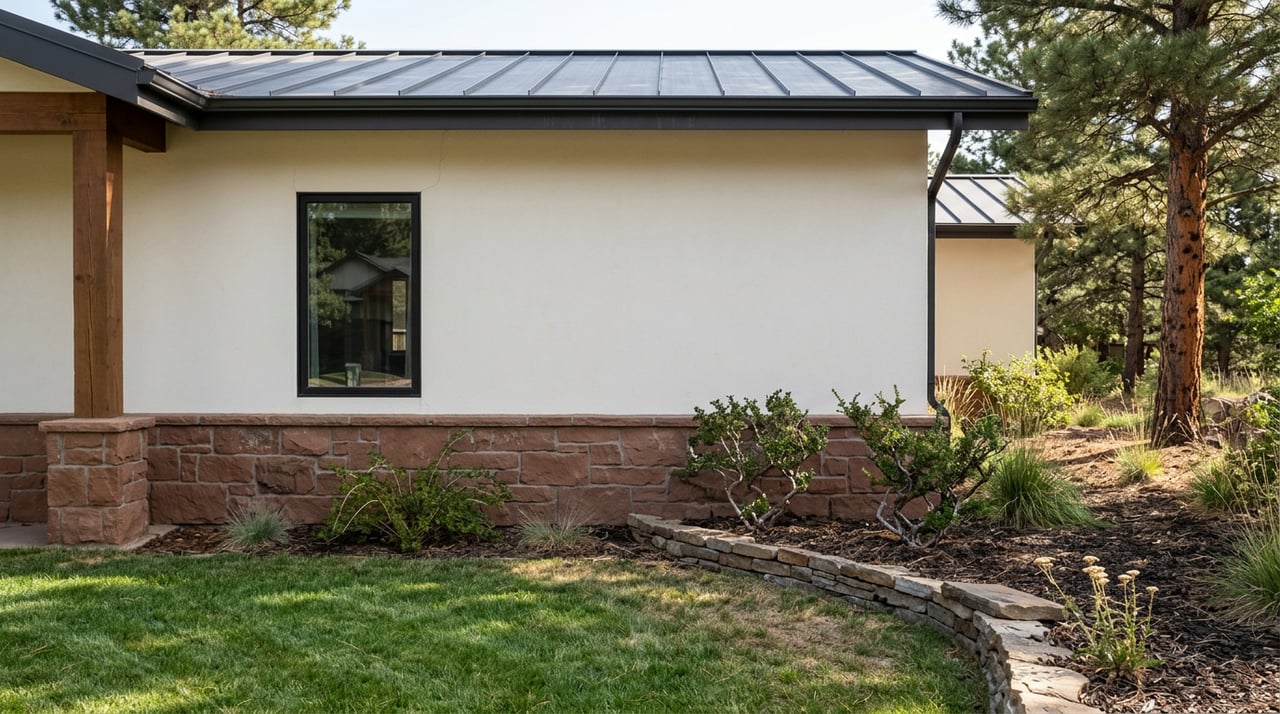
Drive through Woodland Park this August and you'll notice the brown edges. A lawn that's green in the middle and crisping at the corners, a sprinkler head capped with a hand-lettered note about watering days, a "for sale" sign planted in grass that clearly hasn't seen water since Tuesday. If you're new to the market, the easy read is that 2026 is a bad year, the snowpack was thin, and once it rains the sprinklers will run free again.
That's only half true, and the half that's missing matters if you're comparing homes here to anywhere else in the Pikes Peak corridor. The City of Woodland Park has run Level 2 watering restrictions as a standing seasonal program since at least 2021, and the city says outright that it does this every year regardless of drought conditions. What looks like a crisis headline is closer to a zoning rule that happens to get reannounced each spring. That distinction changes what you're actually pricing when you look at a lawn, a lot, or a landscaping budget in this town.
It also changes what "Woodland Park" means as an address, because the restriction only applies if the parcel is actually on the city's water system. A meaningful number of properties with a Woodland Park mailing address aren't.
The Restriction That Keeps Showing Up as News
In April 2026, the City of Woodland Park declared Level 2 Mandatory Water Restrictions, and local coverage from KKTV and CPR News framed it the way most drought stories get framed: rising fire danger, thin snowpack, more Front Range towns cutting back. All of that is accurate. What the coverage didn't spell out is that this isn't a new posture for the city. Woodland Park's own utilities notices describe the seasonal program as something it runs every year, and the city has been at Level 2 before, including the 2021 and 2022 seasons.
The current rules are specific and address-based. Lawns can be watered two days a week on a schedule tied to the last digits of the property's address, no watering is allowed between noon and 6 p.m. from May through September, and nothing runs if wind speeds top 10 miles per hour. New lawns are still permitted, but spray-irrigated turf is capped at 2,500 square feet per property, and any house completed after June 21, 2002 has to submit an irrigation sketch plan before installing one. These details are on the city's own water restrictions page, and none of them are temporary emergency measures. They're the baseline.
The Reason Underneath the Announcement
The city's water treatment page lays out why the restrictions aren't going away with the next good winter. As of 2024, roughly two-thirds of Woodland Park's raw water came from local wells and springs, and about a third was piped in from the city's transbasin water rights, delivered through Colorado Springs' Homestake Pipeline from Twin Lakes Reservoir near the Continental Divide. That imported water isn't a backup plan. It's what makes the local wells legal to use in the first place, because Woodland Park's own groundwater and stream rights are junior in Colorado's priority system, and junior rights only get to run when there's enough water in the system to cover everyone senior to them. The imported water, often called augmentation water, buys the city the right to draw its own local supply.
Augmentation water is expensive, and the city has said so directly. That cost structure doesn't change based on how much it snowed last winter. It's baked into how Woodland Park gets water at all, which is why the restrictions function less like a drought response and more like a standing operating cost that gets passed down to residents as a watering schedule instead of a line item on a bill.
The city currently serves about 4,070 homes, businesses, and institutions, and it's planning limited improvements to its North Well Field near the golf course to support growth toward a service population of 13,500. Even that future expansion is being built around the existing supply constraints, not away from them, which is a reasonable signal that the annual restriction pattern isn't a phase the city is trying to outgrow.
Three Different Water Regimes Behind One Zip Code
Here's the part that actually affects a purchase decision. Not every property that reads "Woodland Park" on the listing is on the city's water system, and the rules above only apply to the roughly 4,000 connections the city itself serves.
| Water source | Who enforces watering rules | New lawn requirements | Typical property type |
|---|---|---|---|
| City of Woodland Park | City Utilities Department, address-based schedule | 2,500 sq ft spray cap, sketch plan required for homes built after June 21, 2002 | In-town lots, established neighborhoods |
| Teller County Water & Sanitation District #1 (Paint Pony Water) | District board, separate from city ordinance | Set by the district, not the city | Properties served by the district's own infrastructure |
| Private domestic well | Not subject to municipal watering schedules | Governed by well permit terms, not city ordinance | Larger acreage outside service areas |
Teller County Water & Sanitation District #1 is a real, active, separate utility. It holds monthly board meetings at the Woodland Park Public Library on East Midland Avenue, and it has its own capital work underway, including a construction project at its treatment plant that began in April 2026. None of that is governed by the city's Level 2 declaration. A property on this district's system could be watering on a completely different schedule, or no fixed schedule at all, depending on what the district itself has adopted.
What This Means When You're Actually Touring a Property
If you're comparing two homes that both say Woodland Park, the honest first question isn't the lot size or the view. It's which entity sends the water bill. A seller can tell you this in one sentence, and a recent utility bill will confirm it. That single fact tells you whether the 2,500-square-foot turf cap and the noon-to-6 p.m. ban actually apply to that parcel, or whether you're looking at a different set of rules entirely, or none at all if the property runs on a private well.
This matters more the bigger the lot gets. On an acre or larger, a 2,500-square-foot irrigation cap means most of the ground is never going to be sprinkler-fed turf under city rules, no matter what you'd prefer. That's not a climate opinion. It's an ordinance doing the same job a smaller lot size would do elsewhere: setting a hard ceiling on how much lawn you can realistically plan for.
There's one more piece worth knowing if landscaping choice matters to you. Colorado's HB 21-1229 limits how much an HOA can penalize a homeowner for a dormant or drought-tolerant lawn during restriction periods. If a listing sits inside an HOA with a green-lawn covenant, that state law is the thing that resolves the conflict, not the HOA's design guidelines.
A Few Questions Worth Settling Before You Assume Anything
- Ask the seller or their agent which utility actually bills the property, city, district, or well, before you factor lawn or landscaping costs into your offer.
- If the home was built after June 21, 2002 and you're planning new turf, budget time for the city's sketch plan approval, not just the sod itself.
- If you're touring acreage outside the city's service boundary, ask directly whether it's on a private well or served by a district like Teller County Water & Sanitation District #1, since neither follows the city's Level 2 schedule.
- If an HOA's landscaping rules seem to conflict with a xeric or dormant lawn, know that state law, not the covenant, generally wins that argument.
Frequently Asked Questions
Does living outside Woodland Park's city limits mean no watering restrictions at all? Not automatically. Some outlying areas are served by Teller County Water & Sanitation District #1, which sets its own rules independent of the city. Properties on private wells aren't subject to a municipal watering schedule, but well water comes with its own set of considerations that are a separate conversation from lawn watering.
How do I find out which water provider serves a specific address before I make an offer? The most reliable way is a recent utility bill from the seller. You can also call the City of Woodland Park Utilities Department directly, or reach out to Teller County Water & Sanitation District #1 to confirm whether a parcel falls inside their service area.
Is this year's restriction likely to get stricter before it lifts in September? The city has said restrictions can tighten if drought conditions persist or ease with significant rainfall, and 2026's Level 2 status reflects both the standing annual program and additional pressure from a below-average snowpack. There's no way to predict the rest of the season with certainty, but the underlying seasonal program itself isn't going anywhere.
Water rules rarely show up on a listing sheet, but they shape what a property actually costs to keep up and what you can realistically plant. If you're comparing homes across Woodland Park, Divide, or the wider Teller County market and want someone who can walk the specifics of a given parcel with you, from the water provider to the buildable ground, Gold District Realty is a good place to start. Get an Instant Property Valuation and let's talk through what a specific address actually comes with.
