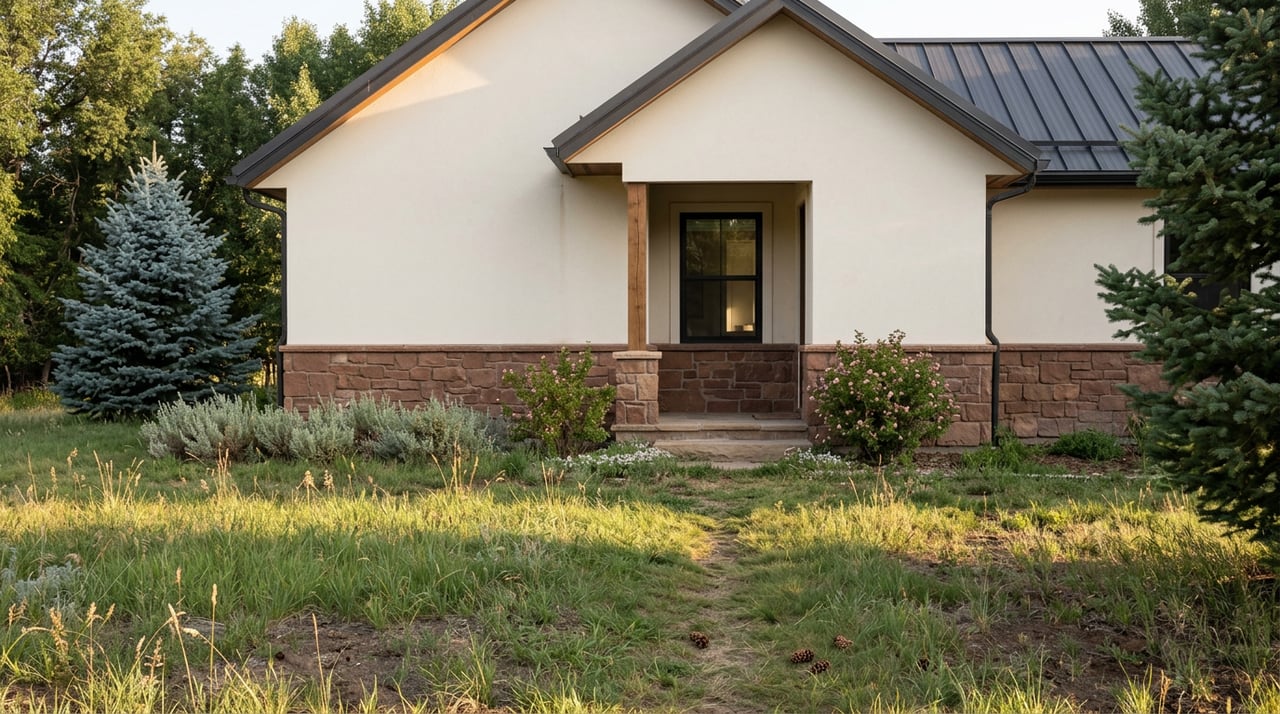
Ask most buyers what they're paying for in Divide, and the answer is almost always the same word: room. Space between neighbors, a driveway long enough that headlights never sweep the windows, elbow room measured in acres rather than feet. That story holds up right up until you look at what an acre actually costs here, because the math runs backward from what the postcard suggests.
Land marketed as Divide "mountain" parcels, typically the smaller, already-improved lots, priced at roughly $56,907 per acre in listings active this July. Homes sold with acreage attached did even better for sellers, averaging about $60,377 per acre. But land marketed plainly as "rural" Divide acreage, the bigger, rawer tracts that come closest to matching what people picture when they say they want privacy, traded for about $33,964 per acre over the same stretch, a discount of nearly 40 percent against the smaller improved parcels.
The bigger the tract, the cheaper the acre. That's not a fluke of one bad comp. It's a pattern, and it matters right now because the thing that actually drives the premium, distance from Divide's center, is about to shrink for a lot of buyers whether they planned for it or not.
The Discount Nobody Advertises
Here's how the numbers broke down across three ways land in Divide gets categorized and marketed, based on listings active in mid-to-late July 2026:
| Divide land segment | Active listings | Average total price | Average price per acre |
|---|---|---|---|
| "Mountain" classified parcels | 140 | $410,881 | $56,907 |
| Houses sold with acreage | 65 | $841,995 | $60,377 |
| "Rural" classified parcels | 40 | $660,166 | $33,964 |
None of these categories is inherently better land. A rural-classified 20-acre tract and a mountain-classified 1-acre lot might sit five miles apart with the same views of Pikes Peak and the same stand of ponderosa pine. What separates them in price isn't the dirt. It's how much work someone else has already done to prove the parcel is buildable.
What You're Actually Paying For When You Pay More Per Acre
Smaller, improved lots in subdivisions like Rainbow Valley and Spring Valley tend to arrive with electricity already run to the lot line and access to an established water district, sometimes with soils testing, a septic diagram, or a roughed-in driveway already done. Someone else absorbed the cost and the risk of proving the land would perch a house, and that work shows up in the per-acre price.
Bigger rural tracts usually haven't had that work done. A buyer gets more total acreage for less money up front, but takes on the well permit, the driveway grading, the septic design, and the wait for utilities, often before a shovel goes in the ground. The lower per-acre price isn't a discount on quality. It's the price of land that hasn't yet been made convenient.
For most of Divide's history, that convenience gap has been a private calculation between a buyer and a surveyor. It's becoming a public one, because the town's actual center is under construction right now.
The Crossroads Is About to Get Busy
Divide sits at the literal crossroads of Highway 24 and Highway 67, and three separate projects are converging on that intersection at the same time.
A new county service hub. Teller County is building a $10 million Central Service Center on the site of Hayden Park's old ball fields, consolidating the DMV, Human Services, Public Health, Community Development and Veterans Services offices that currently sit scattered in rented space across the county. Commissioners are targeting a late 2026 or early 2027 opening, and have said it will be the first time in three decades the county hasn't paid rent for office space.
Affordable housing next door. Crossroads at Divide is a 36-unit apartment building rising at Clark Ranch and Lone Ranger roads, built by AmericaWest Housing Solutions and Riverstone Platform Partners with $1.8 million in federal and $500,000 in state housing tax credits. The mix runs 12 one-bedroom and 24 two-bedroom units across income tiers from 30 to 70 percent of area median income.
Up to 300 new homes across the highway. Alpine Vista is a 61-acre mixed-use subdivision going up on the former Saddle Club property at US 24 and CO 67, developed by Craig and Jessica Nelson. The approved plan allows up to 300 residential units of varying types alongside 100,000 square feet of commercial space. Nelson has said the market will decide the final housing mix, but a resident survey conducted during planning flagged demand for a coffee shop, a child daycare, a dry cleaner, a salon, a sporting goods store and an entertainment center. The project is projected to generate roughly $700,000 a year in property tax once built out, and the county has agreed to maintain the subdivision's two-thirds-mile internal road.
All three sit within a mile or two of each other, at the same intersection that gave Divide its name in the 1880s. A town that has spent a century being defined by open space between things is about to get a government building, an apartment complex, and a small retail district clustered at its center.
What This Does to the Acreage Math
The privacy premium buyers currently pay for small, improved lots close to town isn't going away. If anything, land within easy reach of a functioning DMV, a grocery run, and whatever fills Alpine Vista's commercial square footage becomes more convenient, not less, and convenience is exactly what that higher per-acre price has been buying all along.
What changes is the shape of the discount on the other end. Rural, unimproved acreage further from Highway 24 and 67, the kind bordering Pike National Forest or sitting well outside the established subdivisions like Highland Lakes and Indian Creek, keeps its lower per-acre price for a slightly different reason than it did a year ago. It's not just raw and undeveloped anymore. It's raw, undeveloped, and now measurably farther from a town that's quietly building itself a downtown.
For a buyer comparing a 1-acre improved lot near the crossroads against a 20-acre rural tract further out, the honest question isn't which one is the better deal per acre. It's whether the premium you'd pay for proximity is worth more to you than the acreage you'd give up to get it, and that calculation is about to get a lot more concrete once the service center, the apartments, and Alpine Vista's shops actually open their doors.
Twenty minutes east, comparable homes in Woodland Park have recently traded in the high $500,000s, while similar homes in Divide have priced closer to $350,000 to $450,000, a gap tied directly to lot size, since Divide lots typically run 2 to 5 acres against Woodland Park's more common quarter- to half-acre. That gap has been the whole case for buying in Divide. Watching how it holds up once the crossroads fills in is worth doing before you sign anything.
A Few Questions Worth Settling First
Does the lower per-acre price on rural land mean it's worth less? Not on its own. It usually means the buyer is taking on work the seller hasn't done yet, things like a well permit, a driveway build, or a septic design, rather than paying someone else to have already done it.
Will Alpine Vista change what land near Divide's center is worth? The zoning is approved and construction is underway, but Craig Nelson has said the market will decide the final mix of housing types. The commercial component, once tenants sign on, is the piece most likely to shift daily foot traffic and value along that stretch of Highway 24.
Is Divide still the more private option compared to Woodland Park? For land further from the new crossroads development, yes, typical lot sizes still run several times larger than in-town Woodland Park lots. Closer to the intersection of Highway 24 and 67, that privacy gap is about to get a lot smaller.
If you're weighing acreage in Divide against a smaller lot closer to town services, the numbers on paper only tell half the story. The rest depends on how close you actually want to be to what's rising at that crossroads over the next year. Gold District Realty has walked this ground long before it showed up on anyone's map as a growth corridor, and we can help you read a specific parcel the way the market is about to read it. Get an instant property valuation and let's talk through what your acreage is actually worth right now.
