Water can make or break the value of acreage in Penrose. If you are eyeing irrigated or partially irrigated land, you want clarity on what water actually reaches your fields, what rights are included, and what it will cost to keep it flowing. The good news is you can get clear answers with a focused checklist and a few calls to the right local offices.
In this guide, you will learn the key questions to ask, what to verify on site, and who to contact in Fremont County and the Arkansas River basin for official records. You will also find links to the state and local resources you will use most. Let’s dive in.
Why water due diligence matters in Penrose
Penrose sits in Fremont County within Colorado’s Arkansas River basin, administered by the Colorado Division of Water Resources, also called DWR Division 2. For basin records and enforcement questions, your primary contact is the Division 2 office in Pueblo.
Many irrigated parcels around Penrose and Beaver Park receive water through local mutual ditch companies rather than directly from the county. One local example is Beaver Park Water, which manages reservoirs and ditches and bills shareholders. Delivery depends on priority, season, and ditch rules, not just the number of “shares” listed in a sale.
Start with title and recorded documents
Confirm what conveys
Ask the seller and listing agent which water assets are included in the sale. That means water rights decreed in water court, ditch or reservoir shares, and any recorded easements tied to headgates, pipelines, or ditch access. Request copies of the deed, share certificates, recent assessment bills, and the legal description of the irrigated acres.
Where to verify
Run a title search and check county records for easements, licenses, and liens. The Fremont County Clerk & Recorder is the official source for recorded deeds, plats, and easements. For water-court decrees and cases, search the Division 2 Water Court.
Understand rights, shares, and wells
Prior appropriation and the water court
In Colorado, surface water and tributary groundwater follow the prior-appropriation system. Water rights are separate property interests that are adjudicated in water court and administered by priority date. A listing that claims “irrigated acres” does not prove the legal right to divert a certain flow. Confirm any decree or share documentation and verify details with DWR Division 2 and the water court.
Wells, permits, and augmentation plans
If the property uses a private well, do not assume you can drill a new well or increase pumping. In the Arkansas basin, you often need an approved plan that replaces out-of-priority depletions so senior users are not injured. Read DWR’s overview of augmentation plans, then confirm the property’s well permit number, pump tests, and any plan or decree that governs operation.
Measurement and reporting are increasing
DWR is expanding measurement and reporting requirements for diversions and wells. You may be required to install meters or headgates with measuring devices and keep records. Review DWR’s flow-measurement guidance and ask for any existing meter or diversion records to verify historic use.
Questions for the ditch company
A mutual ditch company controls how and when water is delivered to your acreage. Call early and ask for the bylaws, line restrictions, and contact for the ditch rider.
Delivery logistics to your parcel
- Which delivery line serves the parcel, and where is the headgate or tap?
- How many shares relate to one delivery unit, and what is the defined flow per share?
- How are turns scheduled in a normal and a dry year? Who sets rotation and notifies users?
- Are there recorded easements for accessing the headgate if it sits on a neighbor’s land?
Costs, transfer rules, and obligations
- What are annual assessments and any special assessments for maintenance?
- Are shares restricted to a particular line or place of use?
- What are transfer rules if you sell or move shares?
- Who maintains which parts of the ditch, pipeline, or turnout on your property?
A local example of how these items are handled in the area is outlined in Beaver Park Water’s FAQ.
On-site infrastructure checklist
Before or during your first tour, walk the system end to end. Photograph what you see and note conditions and access.
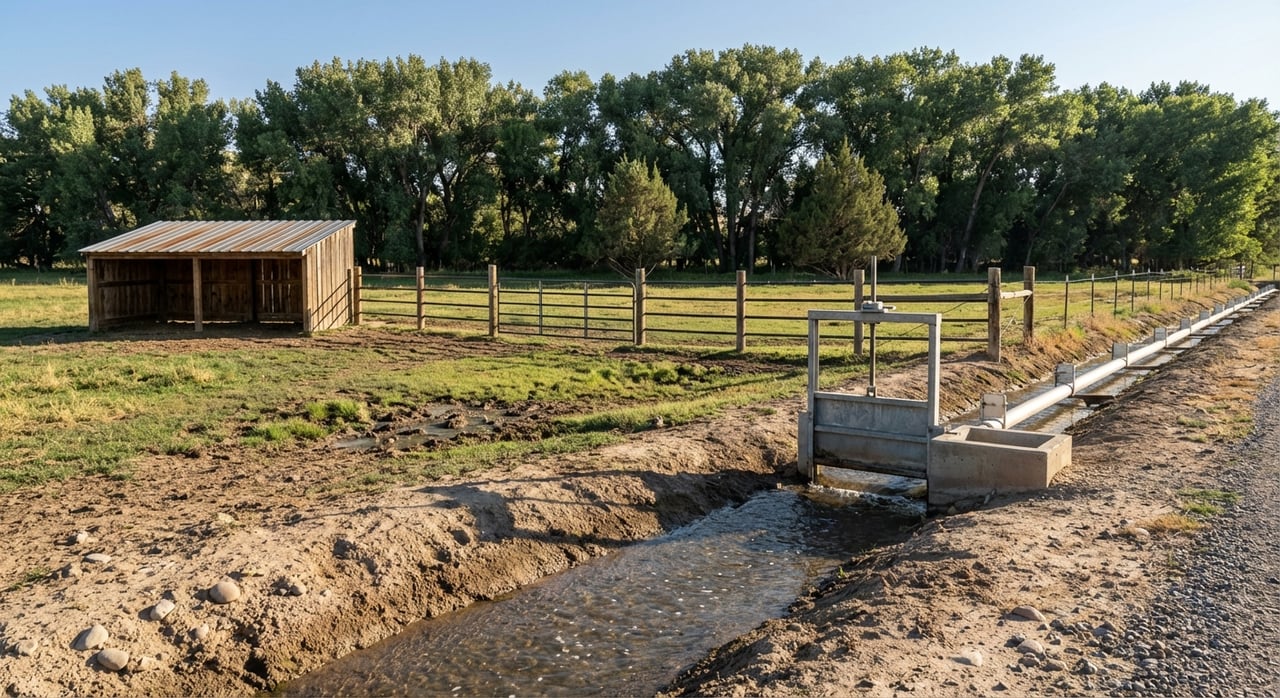
- Headgate or delivery point: location, condition, lock status, and access route
- Measuring device: flume, weir, or meter, plus any recent readings or logs
- Pipelines and laterals: material, leaks, erosion, siltation, and maintenance history
- Pump house: power supply, pump age, controls, and service records
- Sprinklers or hand lines: size, condition, and storage
- On-site pond: whether it is decreed and how it is operated
Ask for maps, recent delivery logs, well logs and pump tests (if applicable), and any repair invoices. For crop expectations and irrigation scheduling, review CSU Extension guidance on crop water use.
Rules that affect upgrades and changes
Converting from flood to sprinklers
In the Arkansas basin, certain irrigation improvements can change consumptive use and may require replacement water. Regional group programs, often called Rule 10 for surface irrigation improvements and Rule 14 for well groups, can help cover replacements. Read local background on Rule 10 and Rule 14 programs, then ask whether your ditch or parcel participates in a group plan and how replacement water is supplied and billed.
Ponds, storage, and floodplain checks
If you see an on-property pond, ask whether it is a decreed storage right. Undecreed ponds can affect senior users and may need a plan. Start with DWR’s overview of augmentation plans and call Division 2 to learn how ponds are handled in your area.
County zoning and land use
If you plan to add structures, subdivide, or change uses, check local rules first. Contact Fremont County Planning & Zoning for zoning, driveway access, and subdivision standards.
What to bring to your first tour
- Deed and legal description
- Ditch share certificates and last two years of assessment bills
- Well permit number and well log
- Any augmentation plan or water-court decree documents
- Septic permit and as-built
- Current survey or a recent boundary map
Also ask the seller or ditch rider:
- When does the ditch usually turn on and off each season?
- Is the parcel early or late in the rotation?
- Has irrigation use been continuous in recent years?
- Have there been any notices or disputes with DWR or the ditch?
Common pitfalls to avoid
- Relying on share count without confirming delivery location, priority, and rotation
- Assuming a new well or increased pumping will be permitted without an augmentation plan
- Ignoring recorded ditch easements that limit fencing, earthwork, or structures
- Skipping measurement compliance and historic-use records that can support your plans
- Planning sprinkler conversions before checking Rule 10 and any group plan requirements
Your next steps
Penrose can be a great place to own irrigated acreage when you understand exactly what water you have, how it is delivered, and what it will cost to maintain. Start with the records at the county, confirm legal status with the Division 2 Water Court and DWR, and speak directly with the ditch company about delivery and assessments. Walk the system carefully on site, and bring in qualified contractors if you are unsure about well yield or infrastructure.
If you want local, boots-on-the-ground guidance as you evaluate options, reach out to Ruthie Grainger for a friendly, no-pressure conversation about your goals and next steps.
FAQs
What counts as an irrigated acre in Penrose?
- It is land that has historically received legal irrigation water and has the physical means to deliver it. Verify with ditch delivery records, DWR data, and recorded documents.
Who do I call to verify a well permit in Fremont County?
- Contact DWR Division 2 in Pueblo and request the well permit file and any related augmentation plan details. Use the Division 2 contact page for guidance.
How do ditch shares work around Beaver Park?
- Shares represent a proportional interest in a ditch company’s available water and come with assessments and rules. Ask the ditch for bylaws, delivery units per share, turn schedules, and transfer rules.
Can I convert flood irrigation to sprinklers on my parcel?
- Maybe, but you must check consumptive-use rules. Conversions can trigger replacement water needs. Ask about Rule 10 participation and any group plan that covers your line.
What does an augmentation plan do for a rural well?
- It allows out-of-priority pumping by providing replacement water so senior rights are not injured. Confirm the plan terms before assuming you can drill or increase pumping.
Where do I find recorded easements for a headgate or pipeline?
- Search the Fremont County Clerk & Recorder’s public records for easements and licenses. Ask the ditch company for any recorded access or maintenance agreements tied to your parcel.
